
Sweet-heat lovers, this one’s for you. Strawberry jalapeño jam marries ripe, sun-sweet strawberries with a gentle jalapeño kick, then locks in flavor and freshness with water-bath canning. This guide covers tested safe ratios, pectin options, heat control, troubleshooting, and a step-by-step canning workflow so you get consistent results and a shelf-stable pantry staple.
If you’re building a resilient homestead pantry, resources like The Self-Sufficient Backyard can help you grow, preserve, and store more of what you eat year-round.
Why sweet-heat jam works for water-bath canning
Jam is one of the safest preserves to can at home because fruit is naturally acidic and sugar binds free water, limiting microbial growth. Strawberry jalapeño jam is an “acidified fruit jam,” which means:
- Safe acidity: Pathogens can’t grow below pH 4.6. Ripe strawberries are typically around pH 3.0–3.9 (safely acidic). Jalapeños are less acidic, so we keep the pepper ratio modest and bolster acidity with bottled lemon juice to ensure a safe final pH.
- Sugar’s role: Sugar doesn’t sterilize, but it ties up moisture and supports gel formation with pectin. You can make full-sugar or low-sugar versions; follow the correct pectin type and directions.
- Pectin and texture: Strawberries are low in natural pectin. You can either use commercial pectin for a reliable set or cook longer for a pectin-free, soft-set jam. Both are safe if acidity and processing times are correct.
- Water-bath suitability: Because of the high-acid environment, jams are processed in a boiling water bath, not a pressure canner. Processing drives out air, creates a vacuum seal, and ensures a safe, shelf-stable product.
Heat control without guesswork:
- Choose the heat level by adjusting how many jalapeños you use and how you prep them (seeds and white membranes contain much of the heat).
- Mince peppers finely for even distribution and a pleasant bite without spicy surprises.
Internal resources to help you level up your canning basics and safety:
- Beginner’s guide to water-bath canning
- Canning safety checklist you can actually follow
- Altitude adjustments for canning
Ingredients, tools, and safe ratios
Here’s a reliable baseline recipe that balances sweetness, acidity, and heat for water-bath canning. It makes about 6–7 half-pints (or 3–4 pints). Stick to these ratios for safety; flavor variations are fine as long as you don’t reduce the lemon juice.
Core ingredients (full-sugar with pectin):
- 4 cups crushed strawberries (about 2 pounds whole fruit, hulled)
- 2–4 medium jalapeños, seeded and minced (keep some seeds for extra heat)
- 1 standard box powdered high-methoxyl pectin (or follow brand’s instructions for low/no sugar variants)
- 1/4 cup bottled lemon juice (bottled ensures consistent acidity)
- 4 cups granulated sugar
Low-sugar option (with low/no-sugar pectin):
- 4 cups crushed strawberries
- 2–4 jalapeños, seeded and minced
- 1/4 cup bottled lemon juice
- 1 box low/no-sugar pectin
- 1.5–2.5 cups sugar, or sugar alternatives per the pectin brand’s directions
Pectin-free option (soft set, deeper fruit flavor):
- 5 cups crushed strawberries
- 2–4 jalapeños, seeded and minced
- 1/4 cup bottled lemon juice
- 2.5–3.5 cups sugar (more sugar speeds gel and improves shelf life)
- Longer cook to reach gel point
Equipment checklist:
- Water-bath canner or a deep stockpot with a rack
- 6–7 half-pint jars (or 3–4 pints), new lids, and bands
- Jar lifter, canning funnel, bubble remover/headspace tool
- Large, wide pot for cooking jam (wide surface helps it gel faster)
- Clean towels, ladle, heatproof spatula
- Thermometer optional but helpful (for checking gel temperature)
Yield notes and safe adjustments:
- Fruit swaps: You can replace up to 25% of the strawberries with finely chopped apples (adds natural pectin) or rhubarb (tart balance). Keep the total fruit volume the same.
- Pepper swaps: Use serranos for more heat or poblanos for milder heat, but maintain the total pepper amount.
- Do not reduce the 1/4 cup bottled lemon juice per 4 cups crushed fruit.
If you plan to stock an emergency pantry with versatile preserved foods, resources like The Lost Superfoods can give you additional shelf-stable ideas to complement your canning routine.
Prep the fruit and peppers for perfect heat and texture
Better prep results in better set and cleaner flavor. Take your time here:
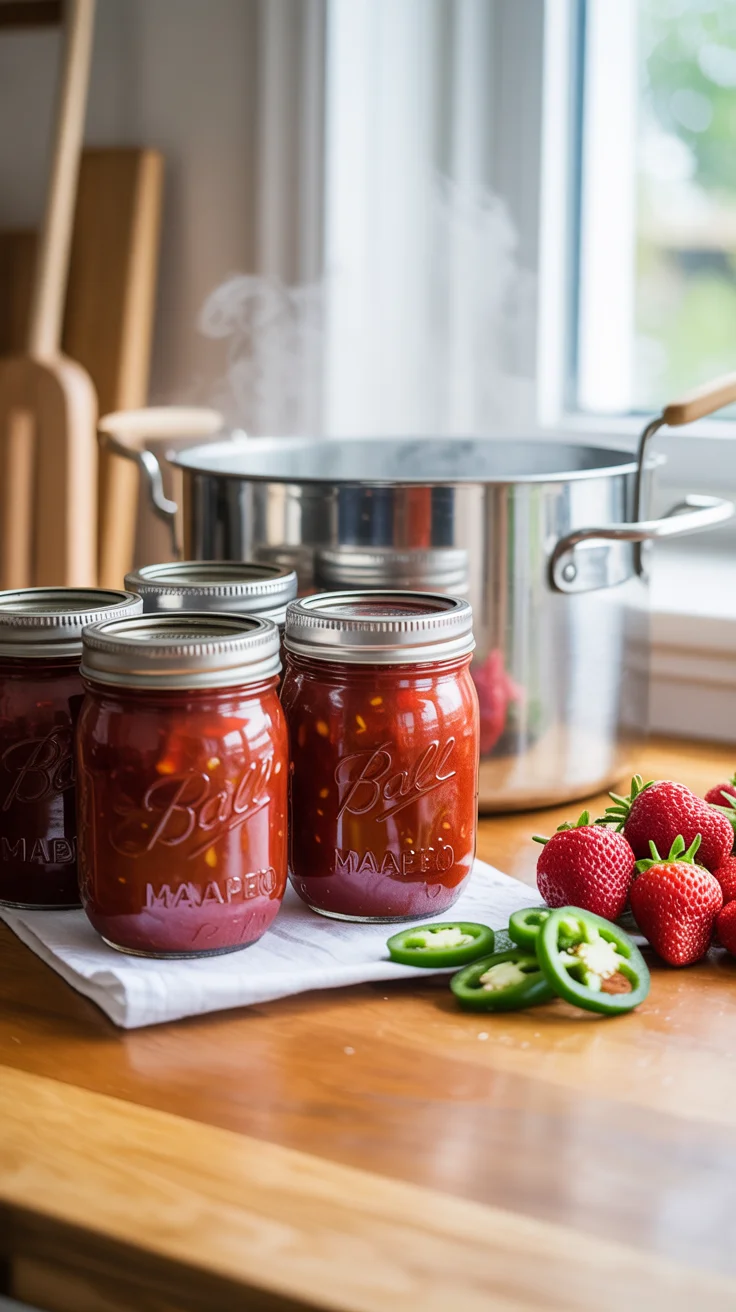
Select and prep strawberries:
- Choose ripe, fragrant berries with bright color and no soft spots. Overripe berries can taste flat and may have more water.
- Hull and rinse quickly; don’t soak strawberries, as they absorb water and dilute flavor.
- Crush berries to a chunky texture rather than blending smooth. Crushing releases pectin gradually and yields a pleasing, rustic jam. Measure after crushing.
Handle jalapeños safely:
- Wear gloves to protect your skin from capsaicin.
- For mild heat: remove seeds and white inner membranes.
- For medium heat: keep half the seeds and membranes.
- For hot heat: keep most seeds and membranes, or add a fifth pepper.
- Mince very finely so pieces suspend evenly in the jam, preventing float and hotspots.
Macerate for better flavor and moisture management:
- Toss the crushed strawberries, minced jalapeños, and sugar (use partial sugar if you’re using pectin that instructs staged additions) in your jam pot.
- Add bottled lemon juice and stir to dissolve sugar.
- Let sit 15–30 minutes. Maceration draws out juices, reduces foaming, and helps the fruit heat evenly.
Pectin choices and setup:
- High-methoxyl pectin (HM): Requires full sugar to set. Typically you add pectin first with the fruit/juice, bring to a full rolling boil, then add sugar and boil hard for 1 minute. Follow your pectin brand’s exact steps.
- Low/no-sugar pectin (LM): Sets in low sugar or with alternative sweeteners. Add calcium water if required by your brand; follow the packet closely.
- Pectin-free: Plan for a longer simmer to reach gel point. Consider adding 1 peeled, finely grated tart apple in the pot to boost natural pectin.
Pro tip for even pepper distribution:
- After cooking, let the jam rest off heat for 2–3 minutes, then stir well before filling jars. This helps suspend pepper bits evenly and reduces float.
Cook the jam: with or without pectin
The cooking stage determines set, flavor concentration, and clarity. Use a wide, heavy-bottomed pot to speed evaporation and minimize scorching.
With HM pectin (full sugar):
- Combine crushed strawberries, jalapeños, lemon juice, and pectin in the pot. Stir well.
- Bring to a full rolling boil you cannot stir down.
- Add all sugar at once; stir to dissolve. Return to a hard rolling boil for 1 minute exactly (or per brand).
- Remove from heat. Skim foam if desired. Let rest 2–3 minutes, stir to distribute solids.
With LM pectin (low/no sugar):
- Follow the package for when to add pectin and calcium water.
- Bring fruit mixture to a vigorous boil and cook per directions, usually a minute after adding sweetener.
- Remove from heat and stir well to distribute peppers.
Pectin-free method (soft set):
- Simmer the macerated mixture over medium-high heat, stirring frequently to prevent scorching.
- As it thickens, stir constantly and skim foam. Cook until it reaches gel point.
- Gel indicators:
- Spoon/shear test: A cooled spoonful should form a sheet that drips slowly, not in separate droplets.
- Wrinkle test: Drop some jam on a chilled plate; push with a finger. If it wrinkles, it’s set.
- Temperature: About 220°F at sea level; reduce roughly 2°F per 1,000 feet elevation.
Taste balance and heat check:
- Briefly taste a cooled dab on a spoon. Add a squeeze more bottled lemon if it tastes dull (do not reduce the original 1/4 cup). Adjust heat next batch by changing seed/membrane amount or jalapeño count—not by adding more peppers at the end.
Foam control:
- A small pat of butter can reduce foam, but some canners avoid dairy. Alternately, skim foam near the end. Foam is cosmetic; it doesn’t affect safety.
Note: Avoid overcooking. Overcooked jam can taste caramelized and become too stiff after cooling. Stop just as you reach the desired set.
Water-bath canning steps and altitude adjustments
Once the jam is cooked, move smoothly into canning while everything is hot. Have your canner simmering before you start cooking the jam.
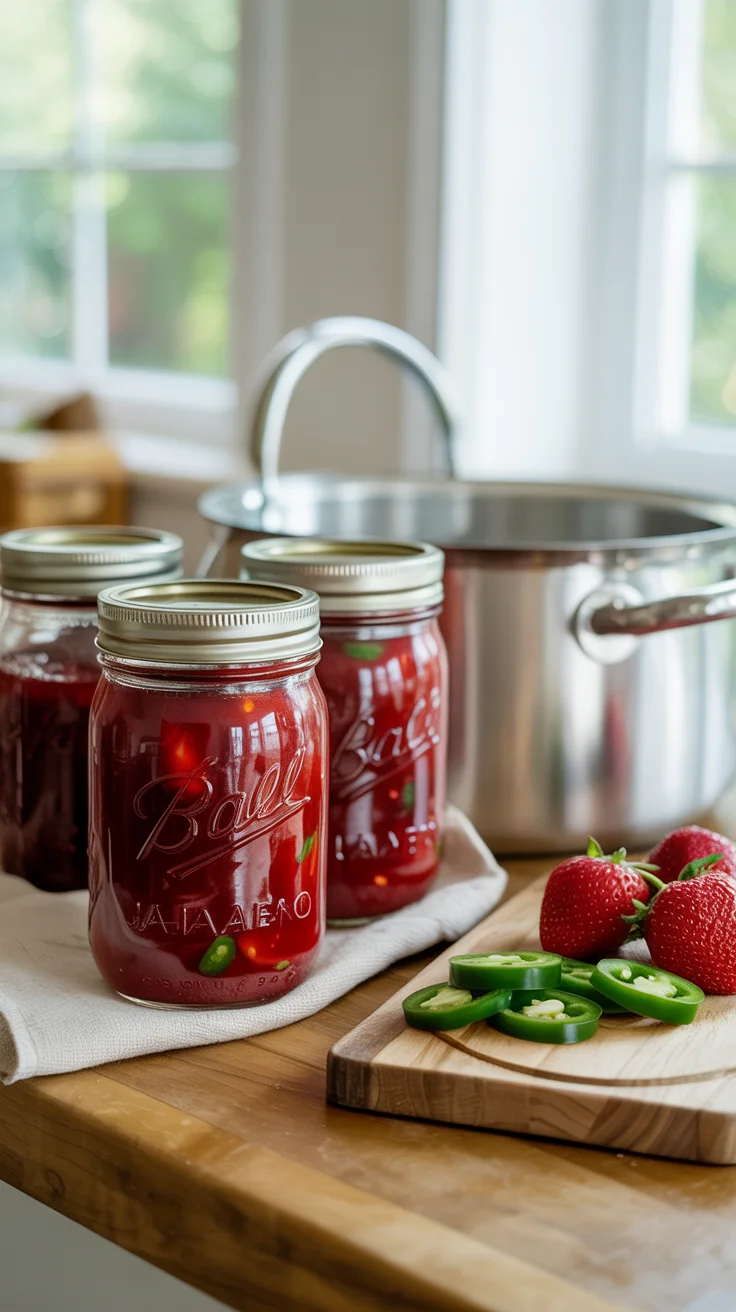
Jar prep:
- Wash jars, lids, and bands. Keep jars hot until use (in the canner or a 180°F oven). Since we’ll process for 10 minutes or more, pre-sterilizing jars is not required.
- Keep lids at room temperature unless your brand specifies warming.
Filling:
- Ladle hot jam into hot jars with a canning funnel, leaving 1/4-inch headspace.
- De-bubble using a clean tool and adjust headspace if needed.
- Wipe rims with a damp cloth. Apply lids and snug bands to fingertip tight.
Processing:
- Place jars on the rack in the canner. Ensure at least 1–2 inches of water covers the lids.
- Bring to a vigorous boil, then start timing.
- Standard processing time: 10 minutes for half-pints or pints.
- Altitude increases:
- 1,001–6,000 ft: process 15 minutes
- Above 6,000 ft: process 20 minutes
After processing:
- Turn off heat. Wait 2–5 minutes before removing jars so temperatures equalize and siphoning is less likely.
- Lift jars straight up with a jar lifter and set on a towel-lined counter. Do not tilt. Do not retighten bands.
- Cool 12–24 hours undisturbed. Check seals: Lids should be concave and not flex when pressed.
- Remove bands, wipe jars, label, and store in a cool, dark place. Best quality is within 12–18 months; refrigerate after opening.
Safety notes:
- If a jar doesn’t seal, refrigerate and use within a few weeks, or reprocess with a new lid within 24 hours.
- Always use bottled lemon juice for consistent acidity when canning this jam.
If you’re preparing for power instability during canning days, a reliable backup like the Ultimate OFF-GRID Generator can keep your cooktop and lights running so you can finish processing safely.
Serving ideas, pairings, and variations
This jam’s balance of sweet strawberries and jalapeño warmth is wildly versatile.
Everyday serving ideas:
- Toast and biscuits: A spoonful brightens breakfast while offering a gentle kick.
- Cheese and charcuterie: It shines with cream cheese, chèvre, brie, sharp cheddar, or cured meats. Add crackers and nuts.
- Sandwiches: Spread on turkey, ham, or grilled cheese for a sweet-heat twist.
- PB&J upgrade: Pair with crunchy peanut butter for a grown-up flavor mash-up.
Savory applications:
- Grilled proteins: Brush onto chicken thighs, pork tenderloin, or salmon in the last few minutes of grilling. The sugars glaze beautifully.
- Burgers and sliders: A thin layer on buns adds brightness to rich meats.
- Roasted vegetables: Toss with roasted Brussels sprouts or sweet potatoes post-roast for a sticky, spicy gloss.
Variations (maintain core safety ratios):
- Lime zest twist: Add 1–2 teaspoons finely grated lime zest for tropical notes (use zest only; do not replace the bottled lemon juice).
- Smoked heat: Use 1–2 chipotles in adobo (minced) in place of some jalapeño for smoky depth. Keep total pepper volume similar.
- Strawberry-balsamic: Add 1–2 teaspoons high-quality balsamic at the end of cooking for complexity (a small amount won’t affect safety).
- Mixed berry: Replace up to 25% strawberries with raspberries or blackberries for added tang and color. Keep lemon juice unchanged.
Entertaining tip:
- Warm a half-pint of jam, whisk with a small splash of apple cider vinegar and olive oil, and you’ve got a zippy vinaigrette for spinach salads with feta and almonds.
Pantry planning:
- Jam makes a superb bartering or gifting item. For a cohesive basket, pair a jar with homemade crackers, a local cheese, and recipe cards.
Mid-content resource for pantry-minded canners: The Lost Superfoods features durable foods that complement home-canned goods in a well-rounded reserve.
Troubleshooting common jam issues
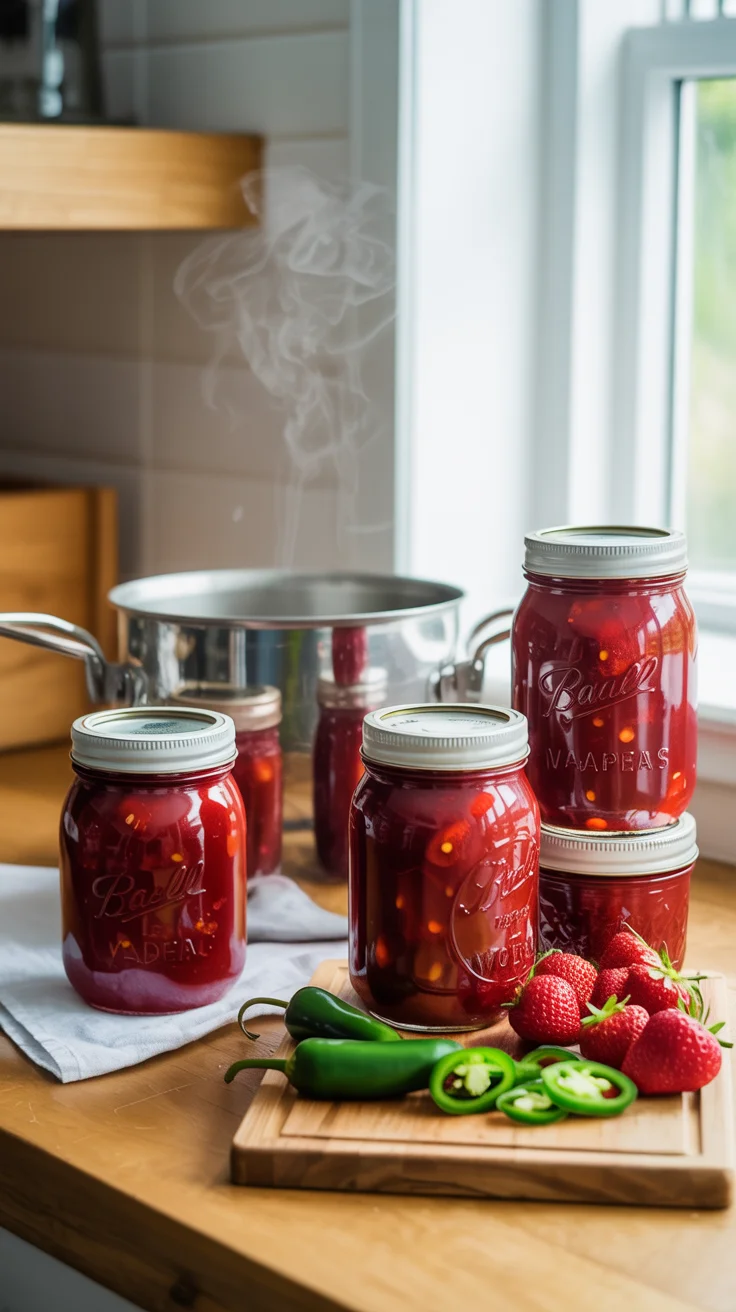
Runny jam after canning:
- First, wait. Jam can take 24–48 hours to fully set.
- If it’s still runny, you can recook and re-can. Open jars, reheat the batch to a boil, and add additional pectin per package directions (or simmer longer for pectin-free). Use new lids to reprocess.
- For next time: Cook a bit longer to gel point, or use low/no-sugar pectin if you prefer reduced sugar.
Too spicy:
- Stir in a second batch of non-spicy strawberry jam and re-can to dilute heat. Or serve the spicy jars with creamy cheeses to balance.
- Next batch: Remove all seeds and membranes, or reduce pepper amount.
Not spicy enough:
- You can’t safely add raw peppers to sealed jars. Instead, note your adjustments and add an extra pepper or more seeds next time. Or fold a spoonful of minced pickled jalapeños into the jam when serving fresh (not for canning).
Pepper float:
- Wait 2–3 minutes off heat before ladling and stir well right before filling jars.
- Finely mince peppers and press out extra moisture before adding to the pot.
Cloudiness or foam:
- Skim foam at the end of cooking. A little cloudiness is cosmetic and harmless. Avoid aggressive stirring that traps air right before filling.
Siphoning (lost liquid in jars):
- Often from rapid temperature changes or overfilling. Let jars rest in the turned-off canner a few minutes before lifting. Maintain 1/4-inch headspace and avoid overtightening bands.
Lid didn’t seal:
- Refrigerate and use within a few weeks or reprocess within 24 hours with a new lid. Check for chips on jar rims and ensure proper headspace.
For more quick fixes, bookmark: Why won’t my jam set?
Get ready for canning season
Build a reliable, homegrown pipeline of fruit and peppers, keep your kitchen powered, and stash a shelf full of bright, lively spreads.
- Grow more at home with solutions like The AquaTower to increase your strawberry and pepper yields in small spaces.
- Ensure canning-day power with the Ultimate OFF-GRID Generator.
- Expand your self-reliance foundation with The Self-Sufficient Backyard and long-keeping pantry strategies from The Lost Superfoods.
Recommended resources
- The Self-Sufficient Backyard: Learn practical homestead systems for growing, preserving, and living more independently.
- The Lost Superfoods: Discover shelf-stable foods and techniques to build a resilient pantry alongside your canned goods.
- The AquaTower: Boost your harvest of strawberries and peppers with a compact growing system for limited spaces.
- Ultimate OFF-GRID Generator: Keep essential kitchen tools and lights running during outages so canning plans aren’t derailed.
Conclusion
With the right ratios, a clear workflow, and a few pro tips, Strawberry Jalapeño Jam (Sweet-Heat) – Water-Bath Canning becomes a reliable, repeatable preserve you’ll make all season. Control heat by how you prep peppers, choose pectin based on your sugar goals, and follow tested water-bath processing times to lock in safety. The payoff is a pantry full of jars that brighten breakfasts, elevate cheese boards, and glaze grilled dinners—sweet, spicy, and shelf-stable.
FAQ
Can you safely water-bath can strawberry jalapeño jam?
- Yes. Fruit jams are high-acid preserves, and with bottled lemon juice (1/4 cup per 4 cups crushed fruit) and proper processing, strawberry jalapeño jam is ideal for water-bath canning. Maintain safe ratios and process 10 minutes (adjust for altitude).
Do you need pectin for strawberry jalapeño jam?
- No. Pectin is optional. With pectin, you get a quicker, firmer set and can fine-tune sugar levels. Without pectin, cook longer to reach gel point for a soft-set, intensely fruity jam. Both are safe if acidity and processing times are correct.
How spicy is strawberry jalapeño jam (can you control heat)?
- Heat is fully adjustable. For mild, remove all seeds and membranes and use two jalapeños. For medium, keep some seeds or use three to four peppers. For hot, retain most seeds/membranes or use a hotter pepper variety. Mince finely for even heat.
Why is my jam runny after canning?
- Jam often firms up within 24–48 hours. If it remains runny, open jars, recook to gel point (or add pectin per package), and re-can with new lids. Next time, ensure you hit gel temperature (about 220°F at sea level) and measure ingredients carefully.