
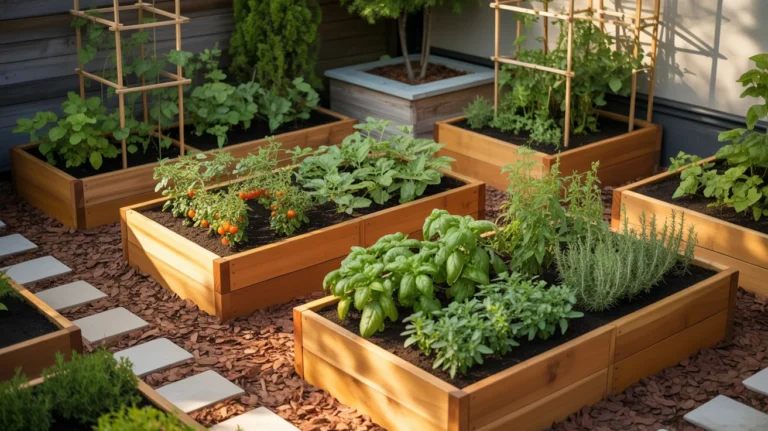
A low-maintenance, high-yield backyard can be both a serene retreat and a productive food garden. When you combine warm minimalism’s calm materials and clean lines with space-efficient food-growing techniques, you get a Low-Maintenance, High-Yield Backyard (Warm Minimalism Meets Food Gardening) that looks refined and produces fresh harvests with less effort. This guide shows you how to design the layout, build healthy soil, select plants that practically care for themselves, and automate the work that usually eats up your weekends.
If you want a practical blueprint for turning small spaces into efficient homestead-style gardens, see the step-by-step guidance in The Self-Sufficient Backyard.
Warm minimalism as a productive garden design system
Warm minimalism isn’t about having fewer plants; it’s about having less visual noise and fewer maintenance tasks. Think natural materials—cedar, stone, matte black steel—paired with simple forms, negative space, and deliberate repetition. Translate that to food gardening and you’ll focus on:
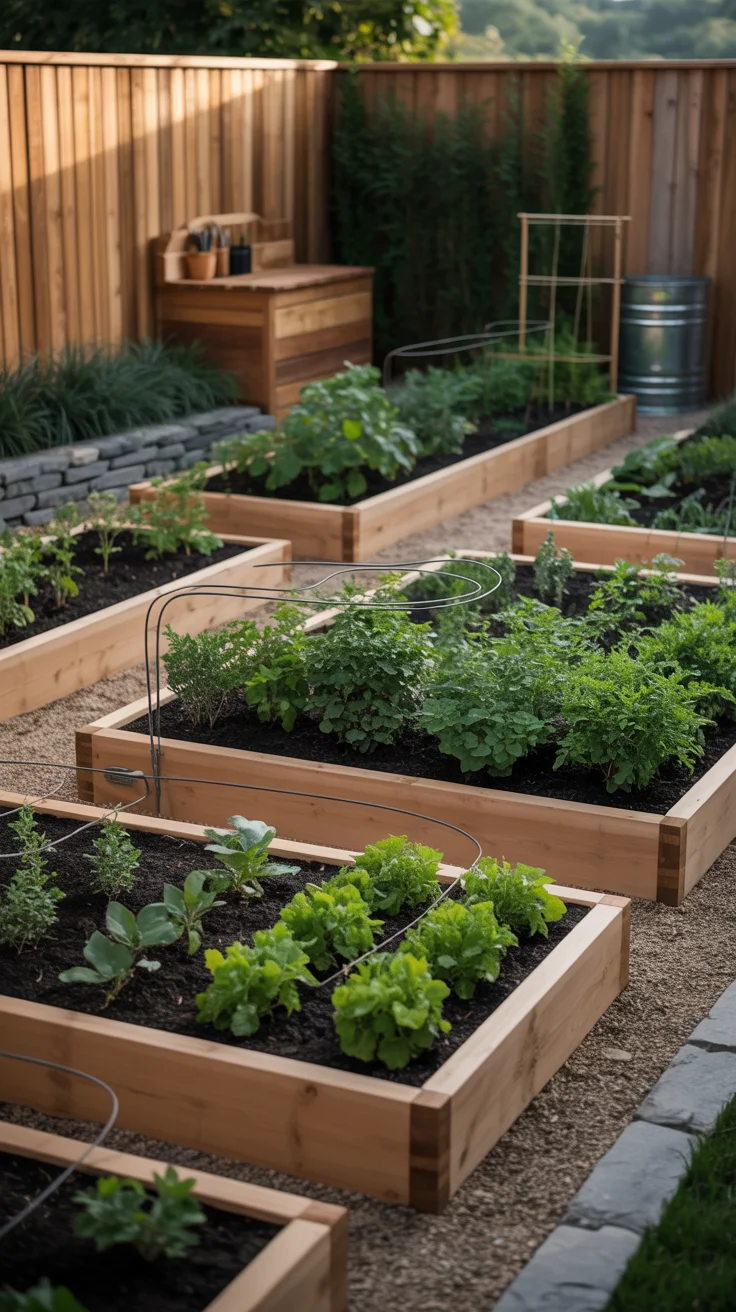
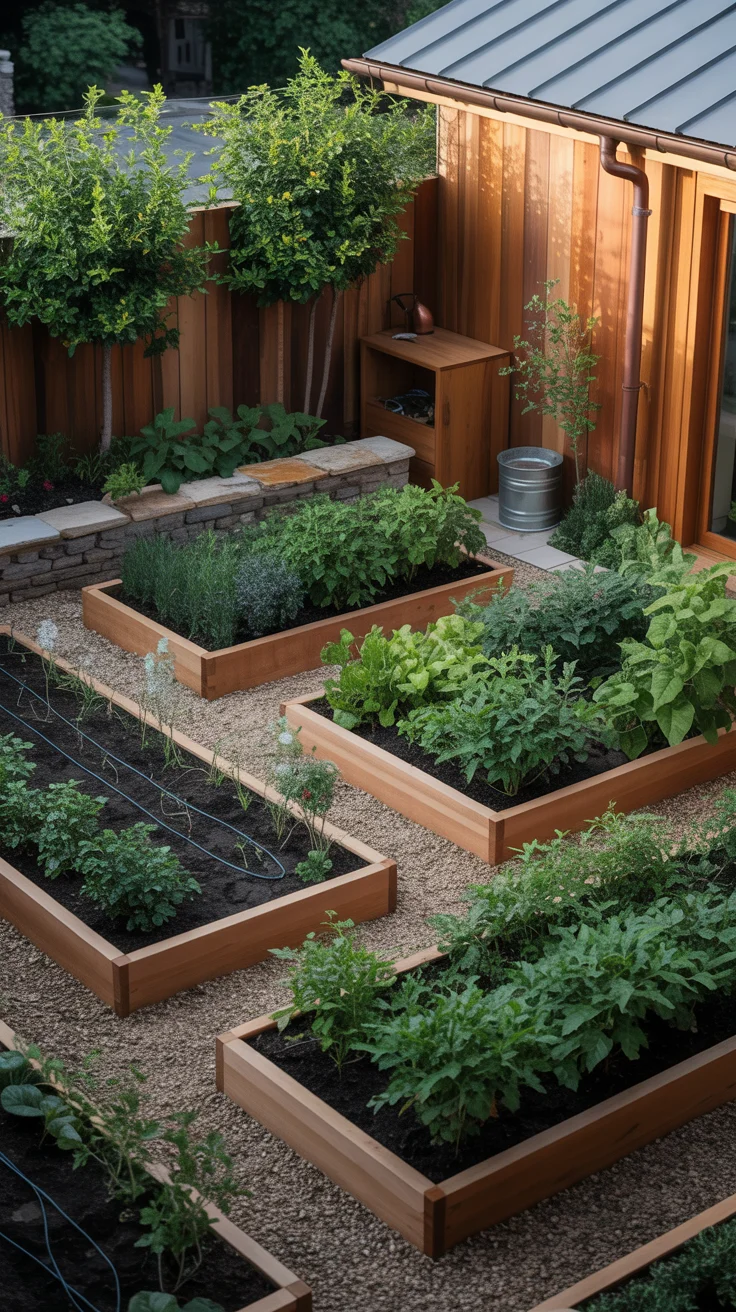
- Fewer but larger beds: Rectilinear raised beds in a repeating grid make planting and maintenance straightforward. One or two bed widths repeated three or four times look cohesive and reduce custom cuts and odd corners.
- Strong structure: Permanent paths, an anchoring tree, a simple pergola, and a straight run of trellis give visual order while performing jobs like shading, climbing support, and circulation.
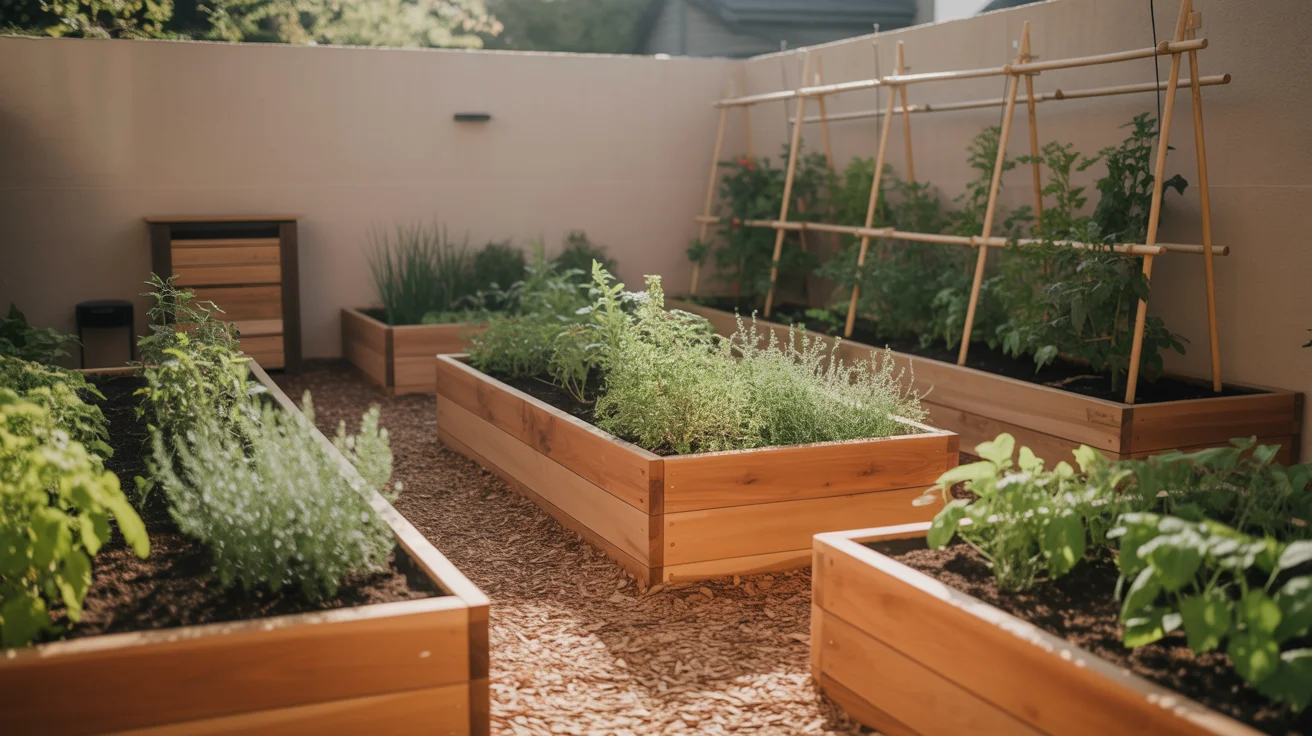
- Hidden function: Conceal compost, hoses, and storage with slatted screens or a tall planter wall. Tuck irrigation manifolds inside a small cabinet. Mount tools vertically inside a narrow shed.
- Calm palette, lush texture: Limit hardscape colors to 2–3 tones and let the greens of herbs and edibles bring life. Choose warm woods and gravel that complement foliage rather than compete with it.
In practice, warm minimalism creates “zones” that make a productive yard easier to manage. One zone for beds and trellises, another for utility (compost, potting, storage), and a third for leisure (bench, dining). Each zone has clear edges and purpose, so tasks don’t sprawl everywhere.
Design heuristics to keep it serene and efficient:
- Repeat modules: 4×8 ft beds or 1×1 m squares repeated.
- Align edges: Beds, paths, and trellises align on a simple grid to reduce wasted space.
- Use vertical frames: Trellis panels act like architectural screens while multiplying growing area.
- Keep sightlines open: Place taller elements at the back or one side to maintain calm vistas.
The result is a garden you can navigate and maintain intuitively, with less clutter and better yield.
Site planning and layout for small, productive spaces
Begin with sunlight, access, and water—then lock them into a simple grid. Even a tiny yard can deliver surprising harvests when every square foot pulls its weight.
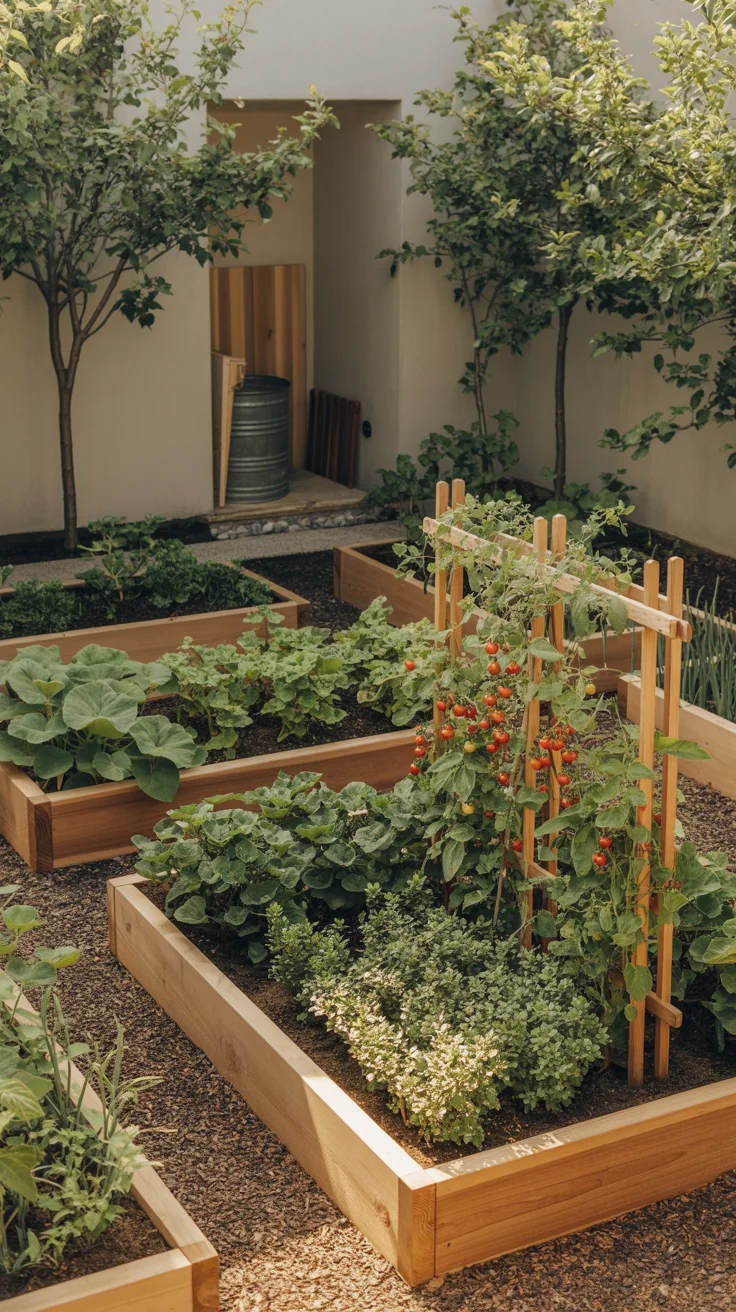
- Map sun and shade: Track where you get 6+ hours of sun for fruiting crops (tomatoes, peppers, cucumbers). Use partial-sun edges for herbs, greens, and berries. Place taller elements where they won’t shade prime bed space.
- Establish the grid: Choose standardized bed sizes (e.g., 30-inch or 90 cm-wide no-dig beds; 4×8 ft raised beds). Set 24–36 inch paths for easy wheelbarrow access. Straight paths reduce weeding and mulch wastage.
- Hardscape for low care: Use compacted gravel or permeable pavers for weed-resistant, low-maintenance paths. Edge beds with steel, cedar, or masonry for clean lines and fewer soil spills.
- Anchor verticals: Install a continuous trellis run on the north or west boundary for climbers (beans, cucumbers, squash). Consider an espalier wire for dwarf fruit trees against a fence to save space and add structure.
- Set up a utility spine: Along the least-visible fence, create a narrow strip for a lidded compost station, a hose bib/irrigation manifold, and a slim shed or cabinet for tools and soil amendments.
High-yield micro-layouts to copy:
- U-shaped bed grouping around a small patio—central seating with surrounding edible borders
- Twin 4×8 beds flanking a straight path with overhead trellis at the end, drawing the eye
- A row of 30-inch no-dig beds with wood-chip paths for efficient seasonal rotation
Make it more productive without clutter:
- Integrate a bench into a raised bed for seating that also supports structure.
- Use a shallow shelf along a fence for seed trays and pruners.
- Run low-voltage lighting along bed edges for evening access and safety.
For a full build list and step-by-step layout options you can adapt for any lot size, bookmark How to plan raised bed spacing and Small-space vertical garden ideas.
Soil health strategies that minimize work
Healthy, living soil is your best timesaver. It reduces watering and weeding, and it keeps plants productive with fewer inputs. You don’t need to till or double-dig. Use this low-effort sequence:
- No-dig beds: Lay down cardboard, add 4–6 inches of compost and 2–3 inches of mulch. Plant directly into the compost layer. Earthworms and microbes incorporate organic matter over time, no shovel required.
- Annual top-ups: Each season, top beds with 1–2 inches of compost. This incremental feeding keeps fertility up without mixing or measuring fertilizers.
- Constant cover: Keep soil covered with living plants or 2 inches of shredded leaves, straw, or arborist chips. Mulch suppresses weeds, buffers temperature, and reduces evaporation (less watering).
- Smart amendments: Add biochar primed with compost tea to boost water-holding capacity in arid regions. Use rock dusts sparingly to replenish trace minerals on long-used beds.
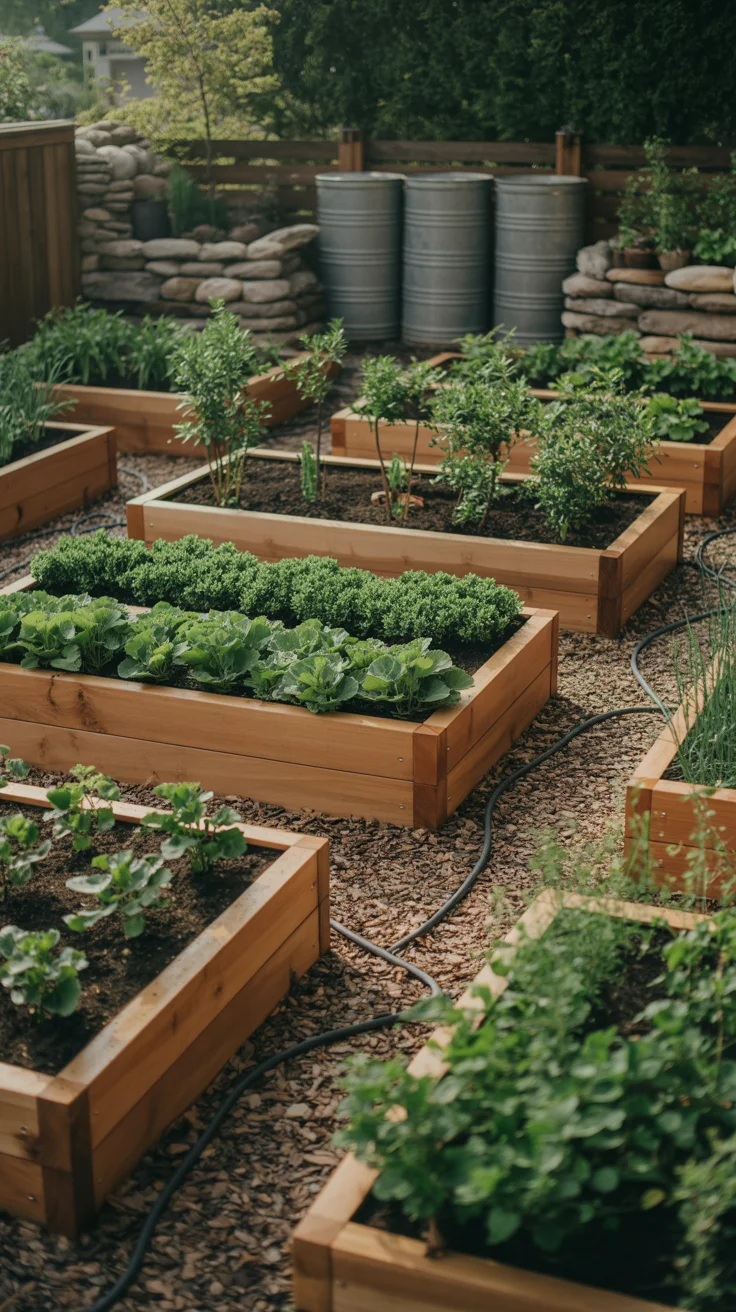
- Drip-first irrigation: Drip lines under mulch deliver water precisely to roots and reduce disease pressure and weed growth between plants.
Weed and pest reduction the quiet way:
- Dense planting: Quick-growing groundcovers like oregano or strawberries shade soil and outcompete weeds in perennial zones.
- Crop rotation: Move plant families each season to manage soilborne pests and diseases naturally.
- Habitat strips: A narrow strip of native flowers near your beds attracts predatory insects and pollinators, improving yields and reducing pest issues.
If you’re starting from scratch, build two beds now and two next season. The no-dig approach scales easily and avoids burnout. For a walkthrough on compost and soil layering, see Compost basics for beginners.
Plant palette for a Low-Maintenance, High-Yield Backyard
Choosing the right plants is the most important “set-and-forget” decision you can make. Aim for a backbone of perennial edibles, a rotation of compact, heavy-yield annuals, and climbers that use vertical space.
Perennial backbone (low care, years of harvest):
- Dwarf fruit trees on semi-dwarf rootstock: apples, peaches, figs, or citrus depending on climate. Train as espaliers to save space and simplify pruning.
- Berries: thornless blackberries, raspberries, blueberries (in acidic soil or containers), currants and gooseberries for part shade.
- Asparagus and rhubarb: long-lived, attractive foliage, minimal yearly upkeep.
- Perennial herbs: rosemary, thyme, oregano, chives, sage. They form tidy mounds and handle drought.
High-yield annuals for small spaces:
- Cherry and saladette tomatoes: more fruits per square foot, reliable in variable weather.
- Bush beans and pole beans: pole types climb trellises and keep on producing.
- Cucumbers (parthenocarpic varieties for reliable fruit set): train up a mesh to save space.
- Zucchini and summer squash: choose compact bush forms and harvest small for higher total yield.
- Greens: cut-and-come-again lettuces, kale, chard; successive sowing gives constant harvests.
- Root crops: radishes and baby carrots for quick wins between slow crops.
Designing sequences:
- Spring: peas on trellis + baby lettuce under; radishes in bed edges.
- Summer: switch trellis to cucumbers/beans; interplant basil and marigold for pest deterrence.
- Fall: plant garlic and overwintering greens after tomatoes come out.
Companion planting principles that keep care low:
- Aromatic herbs among nightshades deter pests and attract beneficials.
- Plant onions and garlic at bed edges for clean borders and pest suppression.
- Use living mulches like clover in perennial lanes to feed soil and reduce weeding.
If you want a condensed roadmap for turning plant choices into harvests month-by-month, the field-tested advice in The Self-Sufficient Backyard can help you plan out the year in a manageable way.
Water-smart systems that look clean
Water is the biggest recurring task in most gardens. Build systems that disappear into your design while doing the heavy lifting for you.
Core strategies:
- Drip irrigation under mulch: Run 1/4-inch drip lines or soaker hoses in rows, covered by mulch to protect from UV and to hide the tubing. Use a programmable timer to water at dawn several times a week—less evaporation, fewer fungal issues.
- Wicking beds: In hot, dry climates or for container gardens, wicking beds store water in a reservoir below the soil and wick it up as needed. They can cut irrigation frequency dramatically and keep surfaces tidy.
- Rain capture: A slimline rain tank along a fence connected to your downspout stores free water. Tie the tank to your irrigation manifold with a filter. The tank can be screened with a cedar slat enclosure to fit the minimalist aesthetic.
- Greywater-ready: If local codes allow, route laundry greywater to a mulch basin near perennial fruiting shrubs. This turns everyday chores into passive irrigation.
Vertical production, minimal footprint:
- Trellis channels against a fence deliver shade to paths and keep vines tidy. Use uniform black welded wire panels for a seamless look.
- Self-contained vertical towers for leafy greens can be placed near the kitchen door for convenient harvests.
If you want a compact, vertical food-growing solution that pairs with drip or recirculating water for high output, consider integrating The AquaTower into one of your sunniest corners. It’s designed to stack production without bloating your footprint, which fits perfectly with warm minimalist constraints.
Resilience add-ons:
- Battery-backed timers: Keep schedules during power blips.
- Off-grid backup: A small generator can keep pumps and lights running during outages. If reliable backup matters for your irrigation or vertical systems, look at Ultimate OFF-GRID Generator as a practical resilience upgrade.
For a DIY drip tutorial with parts list, see How to build a drip irrigation system.
Maintenance routines that feel effortless
Minimalist gardens are built on routine, not rescue missions. A simple cadence and a small toolkit keep everything humming without long weekend marathons.
Weekly, 20–30 minutes:
- Harvest first to reduce pest pressure and signal what’s next.
- Check moisture under mulch. If it’s dry at knuckle depth, increase drip duration slightly.
- Remove weeds while they’re tiny. Mulch makes this a quick pinch-and-go task.
- Tie in vines along trellises, prune tomato suckers as needed, and clip herbs to keep compact.
Monthly, 45–60 minutes:
- Top-dress a handful of compost around heavy feeders.
- Refresh mulch to maintain a consistent 2-inch cover.
- Inspect irrigation lines for pinholes or clogs; flush filters.
- Prune and train espaliers to maintain strong cordons with minimal regrowth.
Seasonally:
- Swap crops per your rotation map; re-seed fast growers in gaps.
- Add a thin compost layer across beds; broadcast cover crop seed in fall for unused areas.
- Service tools—sharpen pruners, oil wooden handles, coil hoses neatly.
Integrated pest management made simple:
- Start with healthy plants and soil—most issues fade when vigor is high.
- Encourage beneficial insects with a small native flower strip.
- Use row cover early on brassicas to skip caterpillar problems.
- Targeted controls only when thresholds are exceeded; avoid blanket sprays.
Keep a small, curated toolkit: a hori-hori, bypass pruners, a narrow hoe, a hand rake, and gloves. Store them in a dedicated weatherproof box by the beds so you’re never hunting around. Minimalism in tools reinforces minimalism in effort—everything has its place, and nothing extraneous gets in the way.
For a quick-start seasonal checklist to print and keep in your shed, see Year-round garden maintenance checklist.
Styling and storage that support productivity
A clean look doesn’t come from hiding the garden—it comes from editing. Let structure do aesthetic heavy lifting while function stays tidy and accessible.
- Material continuity: Choose two hardscape materials and repeat them. Example: cedar beds + warm-gray gravel; or charred wood accents + light limestone pavers.
- Color discipline: Let foliage be the color. Pots, trellis, and furniture stick to neutrals—black, tan, soft white.
- Layered heights: Keep the front low (herbs, greens), middle medium (bush tomatoes, peppers), rear tall (trellised vines, espalier). This ladder effect calms the view.
- Discreet utility: A 24-inch-deep “utility alley” behind a screen stores compost bins, soil bags, and irrigation manifolds. Use a hinged top and lined base for easy cleanup.
- Multi-use elements: Benches with hidden storage, planter boxes that double as retaining walls, and a shallow counter for potting that also serves as an outdoor bar.
Pantry and preservation integration:
- Build a small pantry shelf inside or near the kitchen for drying herbs, storing garlic, and curing onions. Use lidded glass jars and labeled bins for visual order.
- If you’re leaning into food security, curate recipes and storage methods that prioritize shelf-stable ingredients. For inspiration on time-tested staples and preservation ideas, browse The Lost Superfoods.
Lighting and mood:
- Low-voltage LED strips under bench lips and along bed edges add safety and evening ambiance without glare.
- A single, warm spotlight on an espalier or feature tree makes a strong minimalist statement.
The result is a garden that looks curated and calm at a glance—and yet everything you need to grow, harvest, and store food is right where you need it.
Recommended resources to keep your system simple
- A practical, small-space homestead playbook: The Self-Sufficient Backyard
- Vertical production in a compact footprint: The AquaTower
- Backup power for pumps and timers: Ultimate OFF-GRID Generator
Seasonal blueprints for continuous harvests
Consistency is the heart of a high-yield small garden. Use a simple, recurring plan so you always have something coming out and something going in.
Spring setup:
- Beds: Spinach, arugula, lettuces in one bed; peas or early beans on trellis; early carrots and radishes in edge rows.
- Perennials: Prune and feed fruit trees; mulch berries with pine fines (for blueberries).
- Tasks: Install drip, test timers, and set up trellis netting before vines start stretching.
Summer intensification:
- Swap peas for cucumbers or pole beans; underplant with basil.
- Tomatoes: Choose two compact indeterminate varieties for extended harvest and one determinate for a quick flush.
- Succession: Every two weeks, sow a short row of lettuce or bush beans where gaps appear.
Fall consolidation:
- Pull spent summer crops; plant garlic and shallots.
- Sow cold-hardy greens under low tunnels if needed.
- Top-dress beds with compost and mulch heavily to ride through winter low-maintenance.
Micro-harvest planning:
- Prioritize crops that give repeated harvests: kale, chard, herbs, cherry tomatoes.
- Use cut-and-come-again strategies to avoid replanting.
- Stagger plantings so you harvest weekly rather than all at once.
Keep a magnetic whiteboard or simple spreadsheet with three columns: planted, next action, and harvest window. Minimalist systems rely on visibility and predictability. If you prefer a narrative guide to seasonal rhythms that won’t overcomplicate your plan, the field strategies compiled in The Self-Sufficient Backyard can anchor your calendar.
Budgeting time and money for low-maintenance gains
You don’t need a large budget to get a calm, high-output space. Spend where it saves you future effort; save where it doesn’t affect function.
Spend on:
- Bed edges and trellises: Durable materials keep lines crisp and reduce repairs.
- Irrigation: Quality drip and a reliable timer pay for themselves in time saved and consistent yields.
- Soil inputs: Good compost and mulch annually are non-negotiable.
Save on:
- Tools: One excellent pruner and a few multi-use tools beat a closet of gadgets.
- Seeds: Choose open-pollinated varieties for saving, and buy in bulk with neighbors.
- Hardscape: Use locally available gravel, reclaimed pavers, or straight-run deck boards for clean paths and borders.
Time budgeting:
- Setup: Expect 1–2 weekends to build and establish a small grid of raised or no-dig beds with drip.
- Ongoing: Aim for 30–60 minutes per week in-season. Automation and mulch are the biggest reducers of recurring work.
- Seasonal: 3–4 hours per season for transitions (spring startup, summer staking, fall cleanup).
Future-proofing:
- Keep expansion capacity: Leave space for one more bed or a vertical tower if you catch the growing bug.
- Build in redundancy: A rain tank plus municipal water; a manual valve plus a timer; a storage bin with spare couplers and emitters.
For an energy-independent layer that keeps timers and small pumps running through outages—especially if you embrace vertical or recirculating systems—evaluate Ultimate OFF-GRID Generator as a resilience add-on.
Bringing it all together in a Low-Maintenance, High-Yield Backyard
Your goal is an attractive, coherent space that quietly produces. Start with a simple grid and restrained materials, feed the soil without digging, plant a backbone of perennials with compact, high-yield annuals in rotation, and automate watering out of sight. Hide the messy bits in a tidy utility alley, use vertical structures for order and abundance, and keep a minimalist routine you can sustain.
This blend—Low-Maintenance, High-Yield Backyard (Warm Minimalism Meets Food Gardening)—lets your garden be the calmest room of the house and a surprisingly productive one. If you want extra handholding or specialized systems, explore The Self-Sufficient Backyard, The AquaTower, and Ultimate OFF-GRID Generator to round out your setup without cluttering your space or your schedule.
FAQ
What are the most low-maintenance food plants?
- Focus on perennial edibles and tough herbs. Dwarf fruit trees (espaliered apples, figs, citrus), berries (blueberries, raspberries, thornless blackberries), asparagus, rhubarb, rosemary, thyme, oregano, sage, and chives deliver years of harvest with minimal attention. For annuals, cherry tomatoes, bush beans, cucumbers on trellis, kale, and chard are consistent performers. Pair with mulch and drip irrigation to minimize watering and weeding.
How do you reduce garden watering and weeding?
- Install drip irrigation under mulch and set a dawn schedule with a timer to cut evaporation and soil splash. Keep soil covered year-round—living cover crops in off-seasons and 2 inches of organic mulch during the growing season. Plant densely to shade out weed seeds, and top-dress beds with 1–2 inches of compost each season to maintain moisture and soil structure. In hot, dry zones, wicking beds or rain tanks feeding your drip system further reduce watering frequency.
What is a high-yield garden in a small space?
- It’s a garden that prioritizes vertical growing, compact high-output varieties, and continuous succession planting. Use trellises for beans and cucumbers, choose cherry or saladette tomatoes for more fruit per square foot, interplant fast greens between slower crops, and keep a simple rotation map. A minimalist grid with good access increases efficiency, while fertile, no-dig soil and automated watering drive yield without extra labor.
How do you make a backyard look minimal but still productive?
- Limit hardscape materials to two and keep colors neutral; repeat bed sizes and align edges on a grid for visual order. Hide utilities behind slatted screens, use a single continuous trellis for vertical crops, and maintain layered plant heights—herbs front, bush crops mid, climbers and espaliers at the back. Choose a perennial backbone for evergreen structure and intersperse compact annuals for seasonal abundance. This approach delivers the Low-Maintenance, High-Yield Backyard (Warm Minimalism Meets Food Gardening) look and function without clutter.